
Issue 2 - June 2026
/Bullet Dance
an excerpt from BULLET DANCE by Florentino Solano
translated from Spanish to English by Arthur Malcolm Dixon
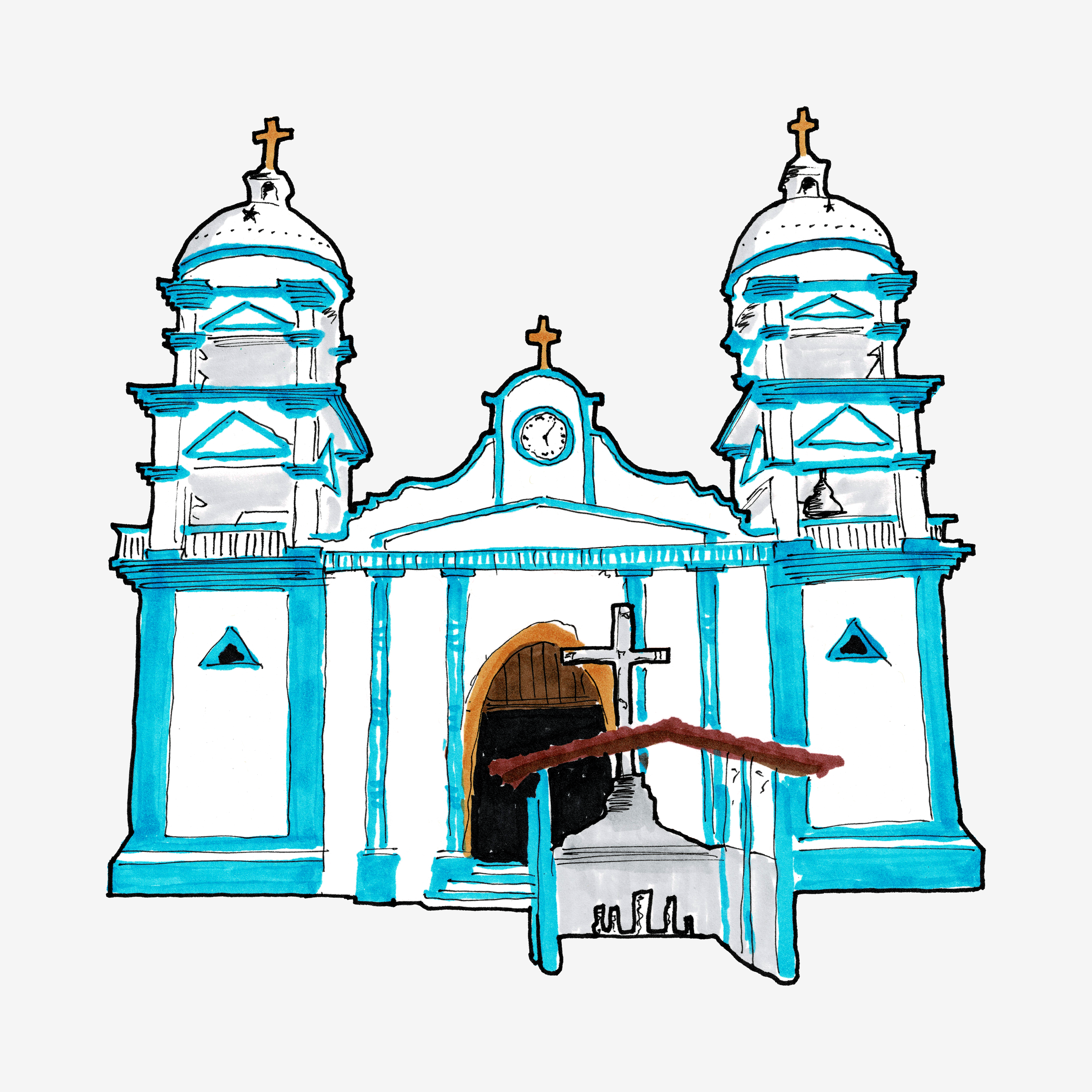
September 25 of the year 2000 was a Monday. It was the sixth day of the feast of Saint Michael the Archangel, one of the most important festivities among the towns of the Mountain of Guerrero. Three groups of dancers led the procession down the main avenue of Metlatónoc. A scarce few meters from the church, a squad of fourteen soldiers crossed paths with the noisy multitude. A dancer portraying a cowboy cast his lasso around one of the uniformed men, who fell abruptly to the ground. When the soldier managed to free himself from the rope, he stood up, raised his Colt M16 rifle to his hip, and pulled the trigger several times in the middle of the crowd. Bewildered by the shots, only a few heard the hiss of the bullets as they hit the wet pavement and then the stones of the church wall, finally ending up buried in the side of a nearby adobe house.
The dancers broke step in unison. The sound of flutes, violins, and drums gradually fell quiet, settling into a sharp, dry silence. The laughter and conversation of the crowd was frozen in a somber, lengthy pause. The bullets punched a hole through the town’s festive spirits. They shattered the patience and deference that its people had shown the soldiers until that moment. The bullets unleashed the uncontrollable fury of men and women who threw themselves against the uniformed bodies, stripping away their weapons in seconds, striking them, scratching them, biting them and spitting in their faces. Held at gunpoint with their own weapons, the “green men,” as they were often called in our town, were dragged to the church courtyard, where a makeshift gallows was going up.
This was the first time the townsfolk had taken up arms to put a stop, once and for all, to the abuses their families had suffered at the army’s hands for more than half a century. The bullets did not pass through a single body that day—out of the Archangel’s grace, many claim—but they had done so hundreds of times before, in hundreds of nearby places, sometimes with no motive at all, no pretext but the simple pleasure of harming another: the pleasure that comes from the most perverse of human instincts. The time had come for them to pay for each and every one of these crimes.
As I remember, very little was said publicly about this clash between the people and the army. Only two reports came out in newspapers, one in La Jornada and the other in El Universal. The government hoped to keep the news under wraps, knowing it would deepen the social crisis in Guerrero and Oaxaca, or at least expose the vulnerability of the military units that encroached upon the mountains. In our town, on the other hand, much was said of this affair for many years. When the story was recalled on feast days, especially the feast of Saint Michael the Archangel, dozens of fireworks went skyward, bands hewed the air with sones and chilenas, and the church bells pealed over and over again. But, years later, the young folks of the new generation began to wonder how that point was ever reached: how something of such magnitude could have taken place in the middle of a town that seems so peaceful, so quiet, so wrapped up in itself. I believe all peoples are sleeping monsters, slumbering in their own customs and traditions; but woe to the one who dares awake them, for once awoken, there is nothing that can hold them back. Death itself trembles before them.
All peoples are sleeping monsters, slumbering in their own customs and traditions; but woe to the one who dares awake them, for once awoken, there is nothing that can hold them back.
So, to understand what happened that day, we must remember, go back, comb through historical memory, and traverse at least half a century. This is the only way to know the stories our Ñuu Savi towns stow away, silently, in some corner of their memory, hoping to forget them forever, to remember them no more. For many of those who live in such places hold stories of great pain and bitterness within them: stories of their own run-ins with the soldiers. Some, if they were lucky, hold these stories only in their memory. But others, who had no such luck, carry these stories as scars all over their bodies. Women, as we all know, carry scars not only on their bodies but also in their souls, as incurable, silent, eternal emotional traumas. These stories of blood and pain do not die with you; rather, they are passed down and suffered for many generations.
One day, two-time municipal president and former state legislator Rutilio Vitervo told me one of many such stories he witnessed while working as an elementary school teacher in the far-off communities of the east. In 1988, a group of soldiers passed through the community of Villa de Guadalupe on their way toward Metlatónoc. They searched, house by house, for guns and poppy resin. In one house, near the school, a soldier came across a fifteen-year-old girl—I will omit her name, of course—laying tortillas on the comal over the wood fire. The soldier spotted a bunch of bananas on the wall, ripening in the heat of the fire. He stripped off two hands and tossed them to his companions, who were waiting by the door. The young girl carried on cutting the dough on the metate to make more tortillas. The soldier leaned in to snatch one of the tortillas the girl was laying on a cloth-covered platter, and she slapped his hand away. Enraged, the soldier grabbed her by the arms, lifted her up, and started beating her on a bed built of cane sticks in the corner. The others, waiting by the door, turned a blind eye while the assailant grappled with the young woman, eager to sate his wicked desires with her body.
Rutilio Vitervo, the community’s only teacher, got word of the attack. As he approached, he started to shout, demanding that the soldiers leave the girl alone and get out of the village at once. One of the soldiers by the door met the teacher with a blow to the stomach. Rutilio writhed in pain as the assailant and his accomplices left the scene, their eyes exuding malice. The teacher pulled himself together and went to the young girl’s aid; her face was soaked with tears of rage and pain. Rutilio had the misfortune of witnessing several such attacks in the communities in which he worked, and so he started conversations with each town’s representatives with the aim of one day becoming municipal president. He swore that, upon achieving his goal, he would forever forbid the soldiers from setting foot anywhere in the Mountain of Guerrero, so that no family would ever again suffer such abuses.
Another day Mr. Rutilio remembers in the greatest detail is March 31, 1998, as the tension between the local people and the army grew ever higher. By then, Rutilio Vitervo was serving as chair of the Party of the Democratic Revolution (PRD) and living in the municipal capital, which afforded him an up-close view of events. It was getting dark on a Tuesday, he recalls, and he had just finished a meeting with a few of his fellow party leaders. As he stepped out the door of the party headquarters to bid his comrades farewell, he saw a caravan of Humvees full of soldiers pass by, returning to Tlapa de Comonfort. He cursed them out and went walking off home. The soldiers drove on twelve more kilometers, reaching the peak of the mountain called the Hummingbird, near the village of San Rafael. There, they waited for a white Ford Lobo from the municipal council to arrive, returning from Tlapa to Metlatónoc with a briefcase carrying 185 thousand pesos: the council’s payroll. The soldiers’ story, which reached the ears of governor Ángel Aguirre, and which the authorities stuck to until the bitter end, was that when they started to head down toward San Juan Huexoapa, another vehicle came up to meet them, and as soon as the municipal vehicle’s passengers were close—evidently drunk and acting thoughtlessly—they opened fire on the military caravan, forcing the soldiers to respond with gunfire of their own. Then, once the attackers had been neutralized, the caravan resumed its course toward Tlapa at top speed.
The municipal treasurer and his companions told a different version of the story: they were driving along, stone-cold sober and completely as normal, when they came up against several military vehicles blocking the dirt road. Eloy Ramón Ortiz, one of the municipal police officers escorting the treasurer, got out of his vehicle to talk to the soldiers. But, instead of words, he was met with gunshots. His companions took cover as best they could in the bed and cabin of the Ford Lobo. Still, all were left severely injured, including the treasurer. Once the soldiers had determined that the municipal police no longer posed any threat, they searched the vehicle at gunpoint and took the briefcase full of money. The municipal police did not fire a single shot; their commander confirmed as much upon his arrival at the scene an hour later.
As this played out, Rutilio Vitervo was having dinner at his home. All of a sudden, a police officer knocked on his door to give him the news. He listened to the details on the way to the town hall, and once he got there, he set out with Don Emiliano Rojas, who was town speaker at the time, for the scene of the crime—the municipal president was not in and Rutilio could be trusted. When they got there, the municipal police commander carried out a quick inspection and determined, based on the evidence, that this had been a premeditated attack by the soldiers. What’s more, witnesses who lived nearby confirmed that the soldiers had taken up position long before the municipal police arrived, as if already intending to lie in wait and shoot them up.
However it happened, the fact remained that Eloy Ramón’s body was lying face-up in the middle of the road, lifeless. He had to be taken to his wife, Nieves Montealegre, and his father, Santiago Ramón, whom Rutilio knew. The teacher would have to carry out this awful task on behalf of the municipal president, who was, at that late hour, sure to be fast asleep in the city of Tlapa. So they lifted the body into the bed of the truck, along with the wounded, and drove back to town at top speed. When they reached the town hall, they dropped off the wounded so the town’s only doctor could examine them, and they brought Eloy’s body to his family. His wife opened the door. She burst into tears when she heard the news. Rutilio, along with the town prosecutor, stayed with the family until after midnight, when more friends and family members came to relieve them: another reason for the teacher to campaign all the more intensely for the municipal presidency. And so, after ten years of tireless community organizing and political alliance-building, Mr. Rutilio Vitervo was sworn in as municipal president on December 1, 1999. That day, he reiterated his commitment regarding the soldiers, standing before a crowd that joyously celebrated his victory. But he could not have imagined that, in less than a year, he would witness one of the most decisive conflicts in Metlatónoc’s history, with the very same soldiers. He had reached the presidency, he had achieved his goal, but it remained to be seen if he had held on to his ideals or lost them along the way.
Florentino Solano is a writer, translator, musician, and farm worker from Metlatónoc, Guerrero, Mexico. He writes in his native language, Tu’un Savi, and translates his own writing into Spanish. In 2021, he received both the Premio de Literaturas Indígenas de América for his chronicle Yaa táxá’á kàà tùxìi (La danza de las balas) and the Premio Nezahualcóyotl de Literatura en Lenguas Mexicanas for his verse collection Tákúu ndi’i tachi si’í yu (Todas las voces de mi madre).
Arthur Malcolm Dixon is translation editor and managing editor of the multilingual literary journal Latin American Literature Today. His translations have appeared in Asymptote, International Poetry Review, The Kenyon Review, Literary Hub, Poesía, Words Without Borders, and World Literature Today, among other publications. He works as a community interpreter in Tulsa, Oklahoma.